| Author |
Message |
Top Top

Joined: Feb 02, 2010
Posts: 266
Location: California
|
 Posted: Sat Aug 07, 2010 3:16 pm Post subject:
5v pulse to 12v? Posted: Sat Aug 07, 2010 3:16 pm Post subject:
5v pulse to 12v? |
  |
|
Dear sirs
I posted about this in the main DIY forum, but so far no bites... I should have known better and just posted it here right away.
I have a TR-505 that I just got from a thrift store that I want to circuit bend and also send clock info to my CMOS synth stuff so they can all play together like happy friends.
I found a clock signal on the 505's board, but when sent to my analog sequencer, it will not advance.
My non scientific guess is that the 505 is putting out only a 5v pulse and my sequencer is running on 12V.
What would be a good way to amplify the 5v pulse up to 12V to play nice with my other stuff?
CMOS based, of course... |
|
|
Back to top
|
|
 |
tjookum

Joined: May 25, 2010
Posts: 360
Location: Netherlands
Audio files: 26
|
| Posted: Sat Aug 07, 2010 4:10 pm Post subject:
|
|
|
For a fast and ugly test just run the cmos synth also at 5v, might even be interesting.
_________________
There he goes. One of God's own prototypes. A high-powered mutant of some kind never even considered for mass production. Too weird to live, and too rare to die.
Hunter S. Thompson
movies
noise |
|
|
Back to top
|
|
|
blue hell
Site Admin

Joined: Apr 03, 2004
Posts: 24509
Location: The Netherlands, Enschede
Audio files: 298
G2 patch files: 320
|
| Posted: Sat Aug 07, 2010 4:17 pm Post subject:
Re: 5v pulse to 12v? |
|
|
| Top Top wrote: | | CMOS based, of course... |
Open drain inverter port, supplied from 5V and output tied to 12 V through resistor (check the specs if this is allowed for the actual device used) ... or just a single transistor of course ... mos or bipolar.
_________________
Jan
also .. could someone please turn down the thermostat a bit.
 |
|
|
Back to top
|
|
|
DGTom

Joined: Dec 08, 2008
Posts: 211
Location: Adelaide
Audio files: 3
G2 patch files: 1
|
| Posted: Sat Aug 07, 2010 7:06 pm Post subject:
|
|
|
I know op-amps are kinda taboo / off limits / not purist around here, but, this is just the kind of thing you'd use a comparator set-up like one of the ones I posted awhile back.
Plugging stuff randomly (via a diode / resistor) into CMOS can be cool but sometimes you want solid + predictable behaviour... if only so that you can get crazier / wonkier further down the chain.
I bet that clock inside the 505 is really tiny as well, not just the voltage, but, the pulse width. By squareing it up & slamming it into the 12V rail with a 358 you could then use it to toggle a 4013 flip flop & get something out of it that will work with anything  |
|
|
Back to top
|
|
|
electri-fire
Joined: Jul 26, 2006
Posts: 536
Location: Dordrecht NL
Audio files: 4
G2 patch files: 4
|
| Posted: Sat Aug 07, 2010 8:04 pm Post subject:
|
|
|
Make sure the Ground of the TR505 and CMOS circuits are connected. If I'm correct, a CMOS Schmitt triggering input should be able to go Hi at about 1/3 of the positive voltage, so in this case from 4 Volts.
EDIT: Oops...Nope, it goes LOW at about 1/3 of the voltage, it goes Hi at about 2/3 of the voltage, so at +- 8V , running a 12V CMOS.
A lot of CMOS ICs have schmitt trigger inputs even when this is not specifically mentioned.
Exact minimum trigger values are in the datasheets.
Last edited by electri-fire on Sun Aug 08, 2010 6:20 am; edited 1 time in total |
|
|
Back to top
|
|
|
electri-fire
Joined: Jul 26, 2006
Posts: 536
Location: Dordrecht NL
Audio files: 4
G2 patch files: 4
|
| Posted: Sat Aug 07, 2010 8:08 pm Post subject:
|
|
|
| Indeed the TR505 circuit runs on 5V. Can you post a pic of where you tapped of the TR505 clock? |
|
|
Back to top
|
|
|
Top Top
Joined: Feb 02, 2010
Posts: 266
Location: California
|
| Posted: Sat Aug 07, 2010 8:46 pm Post subject:
|
|
|
Thanks for the advice guys... some of this stuff I will need to look up/look into more because I wasn't familiar with everything mentioned.
I did make sure the grounds were connected from the two devices though.
The analog sequencer is based around a 4017, so I will check the datasheet to see what the minimum voltage is to trigger it.
| electri-fire wrote: | | Indeed the TR505 circuit runs on 5V. Can you post a pic of where you tapped of the TR505 clock? |
I have closed it back up for now, but I will take a picture when I open it up again. It had a number of clocks in different divisions. The slowest one was slow enough that it was sub audio rate at a moderate tempo on the drum machine, but still definitely at least 2 or 4 times the drum pattern step rate.
It is pretty cool what you can find when you poke around the circuit with an audio probe, as opposed to my regular circuit bending technique where you just poke from one point to another with a wire. There's definitely a lot of cool bends to be done inside the 505. |
|
|
Back to top
|
|
|
electri-fire
Joined: Jul 26, 2006
Posts: 536
Location: Dordrecht NL
Audio files: 4
G2 patch files: 4
|
| Posted: Sun Aug 08, 2010 6:22 am Post subject:
|
|
|
| Oops, error report on the Schmitt Trigger thresholds. Corrected above... |
|
|
Back to top
|
|
|
Top Top
Joined: Feb 02, 2010
Posts: 266
Location: California
|
| Posted: Sun Aug 08, 2010 1:23 pm Post subject:
|
|
|
| electri-fire wrote: | | Oops, error report on the Schmitt Trigger thresholds. Corrected above... |
Ah, that's actually what I thought it was, but hadn't had the chance to look it up yet. |
|
|
Back to top
|
|
|
Psyingo

Joined: Jun 11, 2009
Posts: 248
Location: Canada
|
| Posted: Mon Aug 09, 2010 12:13 am Post subject:
|
|
|
| you could use a couple inverters to make an amp. run the signal into the inverter with a feedback resistor from out to in as well.. experiment with resistor values to get it up to 12v try maybe 100k to start? then run it into another inverter to bring it from being inverted. |
|
|
Back to top
|
|
|
Top Top
Joined: Feb 02, 2010
Posts: 266
Location: California
|
| Posted: Mon Aug 09, 2010 12:30 am Post subject:
|
|
|
| Psyingo wrote: | | you could use a couple inverters to make an amp. run the signal into the inverter with a feedback resistor from out to in as well.. experiment with resistor values to get it up to 12v try maybe 100k to start? then run it into another inverter to bring it from being inverted. |
That's excellent. I actually wondered if you could do that, or something similar to this:
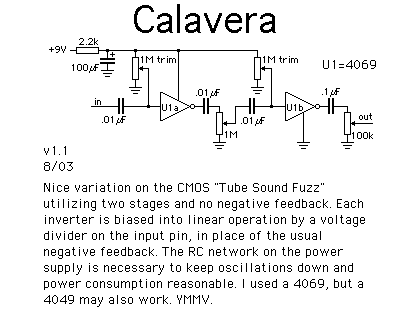
See how he's just biased the input with a DC voltage? I think the two voltages just get added together.
But I guess just a transistor would be simpler... I am not sure how to set it up exactly, but I am prett sure it would just be a transistor, voltage source, and a couple resistors. |
|
|
Back to top
|
|
|
|


 Forum index » DIY Hardware and Software » Lunettas - circuits inspired by Stanley Lunetta

 FAQ
FAQ Calendar
 Search
 Memberlist
 Usergroups
 Register
 Profile
 Log in to check your private messages
 Log in
 Chat Room


