| Author |
Message |
fonik

Joined: Jun 07, 2006
Posts: 3950
Location: Germany
Audio files: 23
|
 Posted: Mon May 31, 2010 4:06 am Post subject:
Reverse Polarity Protection Posted: Mon May 31, 2010 4:06 am Post subject:
Reverse Polarity Protection
Subject description: how to apply it? |
  |
|
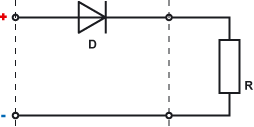
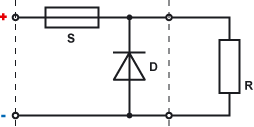
i recently read a little bit about reverse polarity protection. i found two described electronic solutions, serial diode or parallel diode. a third method using a relay is rather expensive.
serial:
parallel:
however, when i tried the serial diode (i used a schottky BAT85) i still saw about 1.7V when applying reversed voltage. the actual circuit was just two LEDs with resistors.
so i ended up using both, serial and parallel. looks like this:
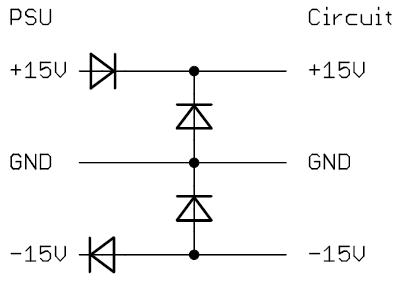
any thoughts about this?
_________________

cheers,
matthias
____________
Big Boss at fonitronik
Tech Buddy at Random*Source |
|
|
Back to top
|
|
 |
Sound
Joined: Jun 06, 2006
Posts: 842
Audio files: 1
|
| Posted: Mon May 31, 2010 12:03 pm Post subject:
|
|
|
Hello Fonik,
The most usual I have seen is only two 1N4002 in parallel. (+ to ground and - to ground)
In series will drop a little the voltage of the supply.
I don't know if the remaining less than 1 volt could damage something.
And it is expected that the fuse of the power supply blow up.
In Eurorack with module connector only with 10 pins, if reversed the connector in the bus board ,CV ,+5 and +12 will be sent to the ground module and then will sent to the ground bus board through de diode. While, signal GATE if present will be sent to the negative rail of the module and then will sent to the bus board ground through the two diodes.
Maybe seems interesting to these two diodes (+ to ground) and (- to ground) add a third diode ( - to +).
Doing it I noticed also that the remaining voltage when shorted drop to less than half of volt.
Also in Eurorack, if the module connector has 16 pins, in addition to what I said you should consider that the negative rail of the bus board will be sent to the module GATE if it does exist.
Last edited by Sound on Mon May 31, 2010 4:04 pm; edited 1 time in total |
|
|
Back to top
|
|
|
frequencycentral

Joined: May 25, 2008
Posts: 186
Location: UK
|
|
|
Back to top
|
|
|
fonik
Joined: Jun 07, 2006
Posts: 3950
Location: Germany
Audio files: 23
|
| Posted: Mon May 31, 2010 11:34 pm Post subject:
|
|
|
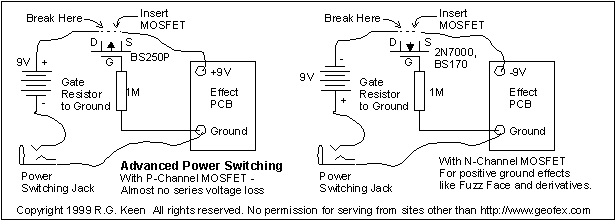
thanks for the link! i embedded the picture for clarity:
www.geofex.com
_________________
cheers,
matthias
____________
Big Boss at fonitronik
Tech Buddy at Random*Source |
|
|
Back to top
|
|
|
toppobrillo

Joined: Dec 10, 2005
Posts: 766
Location: oakland, ca
G2 patch files: 1
|
| Posted: Tue Jun 01, 2010 8:53 am Post subject:
|
|
|
hey Fonik,
the parallel solution looks reasonable to me for 10 pin hdrs. i did not add this to my modules, just marked the PCB clearly. if you were to add small resistors in series with the power lines, you wouldn't have to rely on your power supply's fuse and/or over-current shutdown mode, as the small resistor would burn up like a fuse pretty quickly and the rest of your modules would go on about their business while yours is taken out of circuit.
Blacet uses the same concept with PTC resettable fuses I believe.
http://www.mouser.com/Circuit-Protection/PTC-Resettable-Fuses/_/N-5g3e/ more expensive, but no repairs would be needed [assuming the leakage current is small enough when it's activated that it does not hurt the circuitry]
the idea is that when an over-current situation occurs, like when the diodes conduct and short B+ or B- to gnd in a reverse power situation, the resistance of the PTC goes way up essentially cutting power to the module.
they are generally very fast acting.
If my PCB markings aren't enough to prevent this situation, I will definitely be adding this myself in the future  so far, so good as far I know. so far, so good as far I know. |
|
|
Back to top
|
|
|
fonik
Joined: Jun 07, 2006
Posts: 3950
Location: Germany
Audio files: 23
|
| Posted: Tue Jun 01, 2010 11:25 am Post subject:
|
|
|
thank you very much for sharing, topp.
replacing the resistors would be an ultima ratio, but not what i am looking for. no repairs needed would be great.
so i will have to take a closer look at those PTC resettable fuses: trip current? hold current? funny. anyways, less part count, costs, and boards real estate than the MOSFET, i believe.
_________________
cheers,
matthias
____________
Big Boss at fonitronik
Tech Buddy at Random*Source |
|
|
Back to top
|
|
|
toppobrillo
Joined: Dec 10, 2005
Posts: 766
Location: oakland, ca
G2 patch files: 1
|
| Posted: Tue Jun 01, 2010 12:06 pm Post subject:
|
|
|
| Quote: | | so i will have to take a closer look at those PTC resettable fuses |
cool. well let me know what part #s you narrow it down to. this would make a great de-facto standard method of protection in the euro world, small footprint |
|
|
Back to top
|
|
|
peng

Joined: Feb 23, 2006
Posts: 111
Location: Chicago
Audio files: 2
|
| Posted: Tue Jun 01, 2010 4:51 pm Post subject:
|
|
|
I use the PTC / Blacet method. Works great.
The different PTC parts have different trip points and resistance. The resistance is lower for higher trip points and ideally I would like as close to zero resistance as possible...so it's a trade off. If you already use low value resistors then it shouldn't make much difference to you.
And as far as people plugging in the power wrong:
If it is possible, it will happen!
p. |
|
|
Back to top
|
|
|
fonik
Joined: Jun 07, 2006
Posts: 3950
Location: Germany
Audio files: 23
|
| Posted: Tue Jun 01, 2010 11:47 pm Post subject:
|
|
|
| peng wrote: | I use the PTC / Blacet method. Works great.
The different PTC parts have different trip points and resistance. The resistance is lower for higher trip points and ideally I would like as close to zero resistance as possible...so it's a trade off. If you already use low value resistors then it shouldn't make much difference to you. |
do you have a mouser part# for a start?
_________________
cheers,
matthias
____________
Big Boss at fonitronik
Tech Buddy at Random*Source |
|
|
Back to top
|
|
|
Tim Servo

Joined: Jul 16, 2006
Posts: 924
Location: Silicon Valley
Audio files: 11
|
| Posted: Wed Jun 02, 2010 12:50 am Post subject:
Reverse Polarity Protection |
|
|
Hey Fonik,
I use the same Blacet-style scheme on Magic Smoke stuff. I recommend a 1N4001 or 4148 for the diodes, and a Mouser #652-MFR050-LF for the PTC. This one has a 0.5A "hold current," a 1A "trip current" and a 0.77Ohm (max) resistance when not tripped. The nice thing about the PTC is that if you remove the current and let them cool down, they reset and will operate normally.
Tim (never operates "normally") Servo |
|
|
Back to top
|
|
|
fonik
Joined: Jun 07, 2006
Posts: 3950
Location: Germany
Audio files: 23
|
| Posted: Wed Jun 02, 2010 12:57 am Post subject:
|
|
|
i just took a look at the mancato docs. 
thank you, guys.
_________________
cheers,
matthias
____________
Big Boss at fonitronik
Tech Buddy at Random*Source |
|
|
Back to top
|
|
|
peng
Joined: Feb 23, 2006
Posts: 111
Location: Chicago
Audio files: 2
|
| Posted: Wed Jun 02, 2010 10:20 am Post subject:
|
|
|
I need to do some experiments with these. I'm not sure what the optimum trip point should be. When I tested if these worked some time ago, I just reversed the power to the module. Then I unplugged it, waited a minute, and plugged the power back in the correct way. Module worked fine. But maybe it was the 1N4001 diodes that did all the work. I never checked the PTC to see if it tripped.
If the trip point is high will the circuit fry before it trips?
If I have a small power supply that is protected with a 500mA fuse and if I use a PTC that trips at 1A, will the PSU fuse trip before the PTC?
I have the following three PTC:
Bourns part#-
MF-R010-0-99 , hold 100mA, trip 200mA, max R = 4.5 ohms
MF-R017-0-99 , hold 170mA, trip 340mA, max R = 3.2 ohms
MF-R050-0-99 , hold 500mA, trip 1A, max R = 0.77 ohms
Here is my thinking:
Taking the top PTC (MF-R010), as long as my circuit stays under 100mA the PTC will not trip. If the current demand rises to 200mA it will definitely trip. But what about the in between area (100mA-200mA)?
It might or might not trip in that range?
Does the resistance rise substantially as you edge closer to the trip point?
Obviously I need to do some experiments.
I'm thinking serial connection +V to PTC to resistor to ground. I can adjust the resistor to look at desired current ranges.
Also, circuits with electro supply bypass caps will require a rush of current when first turned on. Now I'm curious to know how much.
Any other thoughts or suggestions or experiments to try out?
I'll post some results ASAP but it just got delayed by one of my favorite things: UPS delivered a new present - parts!
p. |
|
|
Back to top
|
|
|
Tim Servo
Joined: Jul 16, 2006
Posts: 924
Location: Silicon Valley
Audio files: 11
|
Posted: Wed Jun 02, 2010 12:04 pm Post subject:
Reverse Polarity Protection
Subject description: Peng's PTC tests |
|
|
Hey Peng,
I'll be very interested to see your results. I picked the PTC value I did because of what seem to be reasonable current limits (allowing for inrush currents at startup and whatnot), and a low nominal resistance. However, I'll be looking to see how it behaves in a carefully observed short-circuit situation.
Tim (whatnot) Servo |
|
|
Back to top
|
|
|
fonik
Joined: Jun 07, 2006
Posts: 3950
Location: Germany
Audio files: 23
|
| Posted: Wed Jun 02, 2010 2:03 pm Post subject:
|
|
|
wouldn't this question be just academic? i mean, how much current would the module suck when shorted? as much as the psu delivers? and how fast would the current rise?
or do these question not make any sense at all? or are the intended answers wrong?
_________________
cheers,
matthias
____________
Big Boss at fonitronik
Tech Buddy at Random*Source |
|
|
Back to top
|
|
|
|


 Forum index » DIY Hardware and Software

 FAQ
FAQ Calendar
 Search
 Memberlist
 Usergroups
 Register
 Profile
 Log in to check your private messages
 Log in
 Chat Room


