synaesthesia

Joined: May 27, 2014
Posts: 291
Location: Germany
Audio files: 85
|
 Posted: Mon May 11, 2015 12:20 pm Post subject:
The Dub-Stepper Posted: Mon May 11, 2015 12:20 pm Post subject:
The Dub-Stepper
Subject description: A patchable rhythm generator |
  |
|
After the not so harmonic results of playing with the Pulse Beat circuit, I decided to use percussive voices instead of multiple tone generators and started to experiment a bit. Some results are posted in the current controlled oscillator topic. Finally, here is the complete circuit of what I now call the Dub-Stepper. The idea was to generate a simple patchable melody/rhythm generator that is driven by the outputs of a counter. There are five instruments in this circuit: melody, bass, claves, beat and synth drum. There was no intention to properly recreate the sound of the original instrument, they are just meant to create some rhythmic noise. A total of only two chips and some components are used for this fun circuit. The patterns it generates are sometimes simple, and sometimes show a surprising complexity.
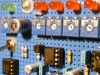
A simple oscillator with a low frequency adjustable by RV1 drives a 4040 counter that is used as the input to all five instruments. Use a HC4040 type here because it can drive a higher output current. As you can see on the PCB photo, I run each output to five pins to allow multiple instruments to use the same clock. Together with ground (for off) and Vdd (for always on) that makes a patch matrix of 14x5 pins at the bottom. The instruments have pin rows with two to five pins at the top of the PCB and are connected via Dupont cables to the matrix. Not something that you want to do live, but suitable for testing and playing around with this circuit.
Lets walk through the five instruments. The melody oscillator is enabled by a high input to R5 and disabled by the input to D1. The frequency is determined by three input resistors R2,R3,R4 and by connecting them to different outputs from the counter, you get different sequences of eight tones. I have added a pot RV4 to change the frequency range, but that can be replaced by a single 1K resistor. The bass is similar, but with a lower frequency and with a set of resistors that are not meant to play many different tones. There are only four tones generated, but with a more complex rhythm depending on the number of inputs at high level to R12,R13,R14. It can be enabled by a high input to R15 and disabled by a low input to D2. The clave sound is generated by an oscillator running at a higher frequency than the melody oscillator and has a trigger input at C23. There is a very short percussive tone generated with a frequency determined by inputs at R7,R8,R9. There is no disable input (but there could be one) so that voice plays continuously as long as there is a gate signal. The beat is similar but uses a very high frequency and a rudimentary VCA with a longer decay. When triggering the sound via the input at C2 it can be modified by the inputs at R17,R18,R19. This is the most interesting instrument in this ensemble and creates pretty interesting patterns that I didn't expect. Choose C8 as small as you can, but not so small that leakage current generate steady clicks. A value of 10nF or a bit less works for me. Finally, the synth drum is triggered by a high level at C4 and can be disabled by a low signal at R20. The frequency can be changed by RV2 from a low drum-like sound to a high bell-like sound with a short decay. A LED indicates the trigger for the synth drum and also serves as a visual clue for the base speed of the rhythm.
Each instrument has a capacitor at the output of the oscillator to filter the sound a bit. electrouwe rightly pointed out that it is not a good idea to feed the output of a CMOS directly to a capacitor because of the high currents that may occur, but I hope to get away with that because of the relatively low voltage used here (I am using 5V, as always) The first four voices are mixed via a resistor network. The output level from the synth drum is much lower because of the simple diode VCA, so it has no resistor before being added to the output. I found the resistor values for the mixer working fine for me, but you may want to consider using pots to adjust the level of each instrument. For completeness, I added a simple transistor amplifier to this schematic. Of course you can grab the output at the volume pot RV3 and use your own amplifier.
In the recording I start with patching the pattern for the synth drum. When happy with a patch, I proceed to the next instrument in the order from bottom to top in the schematic (right to left on the PCB). At the very end I change the overall clock frequency to the highest and then to the lowest speed. Enjoy!
| Description: |
|
| Filesize: |
319.08 KB |
| Viewed: |
522 Time(s) |
| This image has been reduced to fit the page. Click on it to enlarge. |

|
| Description: |
|
| Filesize: |
66.47 KB |
| Viewed: |
846 Time(s) |
| This image has been reduced to fit the page. Click on it to enlarge. |

|
| Description: |
|

Download (listen) |
| Filename: |
DubStepper.mp3 |
| Filesize: |
6.21 MB |
| Downloaded: |
1289 Time(s) |
|
|
Steveg

Joined: Apr 23, 2015
Posts: 184
Location: Perth, Australia
|
| Posted: Mon May 11, 2015 3:06 pm Post subject:
|
|
|
I liked that. to some extent that is similar to the effect that I am looking for.
Just a word of caution to anyone replicating this circuit. The BC547 has an emitter - base breakdown voltage of 6 volts. It is possible for this to be exceeded when the transistor base is pulled low if your supply voltage is higher than around 9 volts. Causing emitter - base breakdown can damage or destroy the transistor. To prevent that put a diode between the emitter and the oscillator capacitor. |
|


 Forum index » DIY Hardware and Software » Lunettas - circuits inspired by Stanley Lunetta



 FAQ
FAQ Calendar
 Search
 Memberlist
 Usergroups
 Register
 Profile
 Log in to check your private messages
 Log in
 Chat Room


