| Author |
Message |
bigtex

Joined: Mar 30, 2006
Posts: 323
Location: Cupertino, California
|
 Posted: Mon Aug 21, 2006 6:38 pm Post subject:
Modifying an older EPROM drum machine Posted: Mon Aug 21, 2006 6:38 pm Post subject:
Modifying an older EPROM drum machine
Subject description: The MXR 185 Drum Computer to be exact |
  |
|
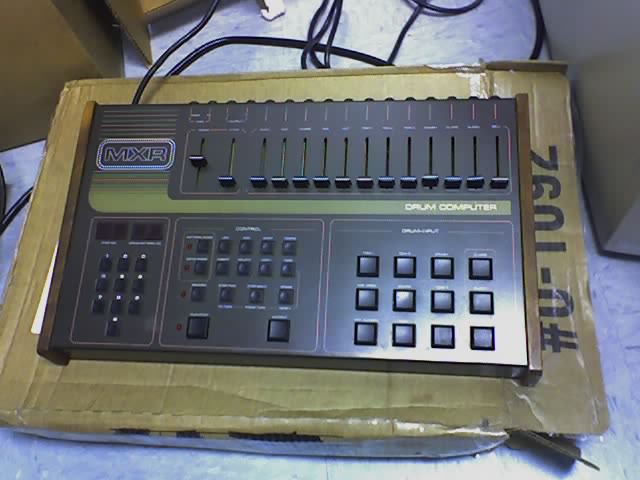
I just got an MXR 185 Drum Computer for a mere $15! Check out the sexy wooden end-cheeks. They just don't make stuff like this anymore. It's a serious solid steel tank inside.
It's got an EPROM per voice, and for some voices it has multiple ROMs.
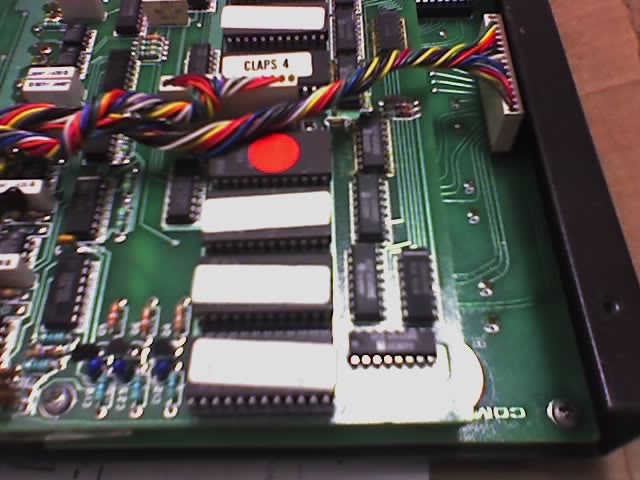
There are a few different things I could do here. I don't have an EPROM reader/burner, but I could make/get one. Then I could make new voice ROMs. This was apparently done with some amazing results to an Alesis HR-16, so why not this one, right?
My other idea is to try to adjust the pitch clock on these more drastically than the pitch knob on the front panel allows. Dave Wright did this to a Roland TR-505 (scroll down a little bit) and it had two different oscillators. I guess there were two voice ROMs, so each one has it's own clock. If that worked with two clocks, why not a seperate clock for each voice? Look at all these preeeety ROMssss:
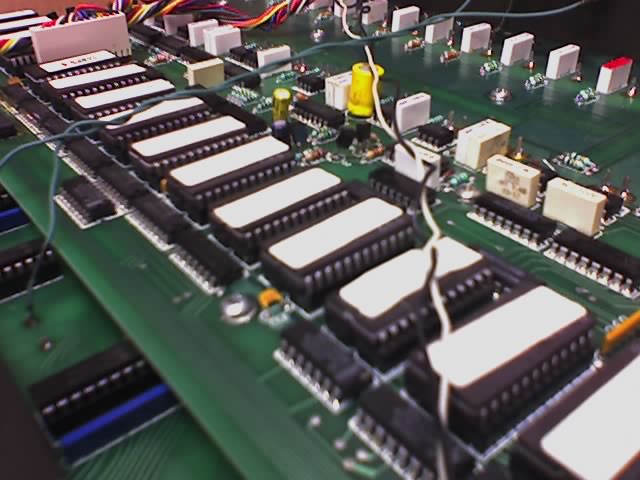
I'm hoping I can pitch the voices individually. This should be possible, right? I'm assuming that the traces that feed the master clock to the respective voices could be cut, and I could put a new square wave oscillator in for each voice. I could then install pots, or even have CV control over each voice's pitch. There's already a trigger input jack on the back (some kind of crazy square 24 pin molex dealie) so I could really integrate this into a modular setup once I get some nice step sequencer action going on.
So to persue that second option, I'd need a bunch of simple square VCOs. Proper 1V/oct would not be necessary, but it would be nice. The simplest method I can think of would be an AVR, but I don't know if they make one with 12 analog inputs. I suppose I could try another microcontroller if not...
Or just a simple logic gate oscillator would be nice. Is there an easy way to make these voltage controlled without using a vactrol or other voltage controlled resistor? Then I'd only need two hex inverters' worth (since the drum machine has 12 voices).
Now these EPROM drum machines, do they have a binary counter to cycle through the memory when the drum sample is to be played? Does the onboard OS have to spit out the addresses to the ROMs? Do the EPROMs just "know" to dump out all of their memory? How is this handled? I've never messed with these old digital drum machines before.
I'm a chronic project starter. I keep coming up with ideas before I finish previous projects... |
|
|
Back to top
|
|
 |
ian-s

Joined: Apr 01, 2004
Posts: 2672
Location: Auckland, New Zealand
Audio files: 42
G2 patch files: 626
|
| Posted: Mon Aug 21, 2006 7:14 pm Post subject:
|
|
|
I modified an OB DX drum machine in the early 80's. I burned the 4 kick/snare options which were in separate EPROMS, into one larger EPROM and added a couple of switches to select.
From memory, each voice of the DX had it's own tunable oscillator, address counter and set/reset logic. All the cpu did was supply the trigger and accent signals. I think microcontrollers of that era would struggle to generate all the address lines (but I could be wrong).
The DX used companding, 8 bit DACs which would slightly complicate the process of making new EPROMs
Cool looking unit BTW |
|
|
Back to top
|
|
|
bigtex
Joined: Mar 30, 2006
Posts: 323
Location: Cupertino, California
|
| Posted: Tue Aug 22, 2006 12:49 am Post subject:
|
|
|
| g2ian wrote: | | I modified an OB DX drum machine in the early 80's. I burned the 4 kick/snare options which were in separate EPROMS, into one larger EPROM and added a couple of switches to select. |
Hey, neat trick. If these 2716 EPROMs weren't so expensive, I'd just buy a whole lot of new ones. Then I could stack them on the old ones and put on switches for the chip select/enable pins.
| g2ian wrote: | | From memory, each voice of the DX had it's own tunable oscillator, address counter and set/reset logic. |
So my guess was right? A binary counter would be used on each ROM to generate the address, all controlled by a common playback rate clock, right? I need to look again at the board and start identifying chips.. and just answer these questions for myself. But I think this would work. New clock for each counter.
The voices with multiple ROMs must have more bits in their address to allow them to span chips like that. Oh, and how would the counter know to stop? Perhaps a specific bit would be wired to the reset pin or something so when it jumps form, say 0FFF to 1000, it would stop. Okay, enough with the speculation. Time to get my reverse engineering hat on. 
| g2ian wrote: | | All the cpu did was supply the trigger and accent signals. I think microcontrollers of that era would struggle to generate all the address lines (but I could be wrong). |
Which makes me think... I could just keep the voice board and replace the CPU and button board with a new one using a modern microcontroller. Hell, I could even generate addresses with a new CPU and do fancy playback tricks like arbitrary loop points, bending, stretching, etc.
Or put on bigger ROMs with multiple samples per channel and do wavetable scanning.... oh that's too much...
But I'm getting ahead of myself... I have this problem with coming up with too many ideas, making things too complex, and then never getting back to my original simple idea... never finishing anything... |
|
|
Back to top
|
|
|
toppobrillo

Joined: Dec 10, 2005
Posts: 766
Location: oakland, ca
G2 patch files: 1
|
| Posted: Tue Aug 22, 2006 1:26 am Post subject:
|
|
|
| Quote: | | But I'm getting ahead of myself... I have this problem with coming up with too many ideas, making things too complex, and then never getting back to my original simple idea... never finishing anything... |
me too, my man.. me too. |
|
|
Back to top
|
|
|
seraph
Editor


Joined: Jun 21, 2003
Posts: 12398
Location: Firenze, Italy
Audio files: 33
G2 patch files: 2
|
| Posted: Tue Aug 22, 2006 5:02 am Post subject:
|
|
|
| topp wrote: | | Quote: | | But I'm getting ahead of myself... I have this problem with coming up with too many ideas, making things too complex, and then never getting back to my original simple idea... never finishing anything... |
me too, my man.. me too. |
| Pierre de Coubertin wrote: | | “The important thing in life is not to triumph but to compete.” |

_________________
homepage - blog - forum - youtube
| Quote: | | Don't die with your music still in you - Wayne Dyer |
|
|
|
Back to top
|
|
|
|


 Forum index » DIY Hardware and Software

 FAQ
FAQ Calendar
 Search
 Memberlist
 Usergroups
 Register
 Profile
 Log in to check your private messages
 Log in
 Chat Room


