| Author |
Message |
Top Top

Joined: Feb 02, 2010
Posts: 266
Location: California
|
 Posted: Tue Jan 17, 2017 3:25 pm Post subject:
Setting trigger threshold on CMOS logic gates? Posted: Tue Jan 17, 2017 3:25 pm Post subject:
Setting trigger threshold on CMOS logic gates? |
  |
|
Let's say I want to convert a 4V pulse to a 12V one.
How do I set a CMOS gate to register an "on" state at +4V, even though the supply voltage is +12V?
_________________
∆ A.M.P. ESOTERIC ELECTRONICS ∆ |
|
|
Back to top
|
|
 |
Grumble
Joined: Nov 23, 2015
Posts: 1319
Location: Netherlands
Audio files: 30
|
|
|
Back to top
|
|
|
PHOBoS
Joined: Jan 14, 2010
Posts: 5881
Location: Moon Base
Audio files: 709
|
| Posted: Tue Jan 17, 2017 4:09 pm Post subject:
|
|
|
hmm from 4 to 12 is a bit much otherwise you might have been be able to get away with adding an offset voltage to the input with 2 resistors.
I haven't tried that though. Usually I add a transistor to the input (which also inverts but that can sometimes be useful) or you could use a comparator.
I am not familiar with the CD4504, looks interesting.
_________________
"My perf, it's full of holes!"
http://phobos.000space.com/
SoundCloud BandCamp MixCloud Stickney Synthyards Captain Collider Twitch YouTube |
|
|
Back to top
|
|
|
Top Top
Joined: Feb 02, 2010
Posts: 266
Location: California
|
| Posted: Tue Jan 17, 2017 4:18 pm Post subject:
|
|
|
| PHOBoS wrote: | hmm from 4 to 12 is a bit much otherwise you might have been be able to get away with adding an offset voltage to the input with 2 resistors.
I haven't tried that though. Usually I add a transistor to the input (which also inverts but that can sometimes be useful) or you could use a comparator.
I am not familiar with the CD4504, looks interesting. |
Well the actual scenario here is that I want to output a 13V clock from a machine that is otherwise running on 6V in order to sync it with other machines.
Adding an offset voltage to the input with two resistors - would that be one from + and one from gnd?
_________________
∆ A.M.P. ESOTERIC ELECTRONICS ∆ |
|
|
Back to top
|
|
|
PHOBoS
Joined: Jan 14, 2010
Posts: 5881
Location: Moon Base
Audio files: 709
|
| Posted: Tue Jan 17, 2017 5:54 pm Post subject:
|
|
|
hmm I'd need a bit more information. If it is running on 6V it would be pretty tricky to get 13v out. You'd need a voltage doubler and some
other things or at least get that voltage from somewhere. However, adding a circuit to inputs so they work on a lower voltage shouldn't
be too hard. Forget what I said about adding an offset voltage, you can't just simply add voltages together 
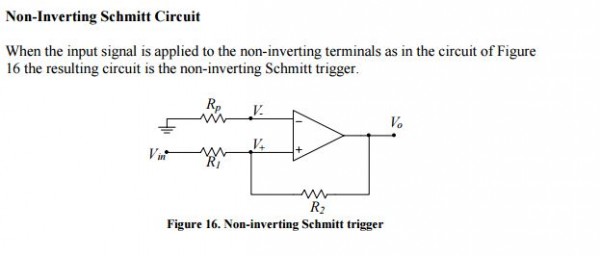
I think a comparator made with a single opamp would probably be the easiest solution and you could use a trimpot to set the reference voltage
which would make it easy to calibrate.
_________________
"My perf, it's full of holes!"
http://phobos.000space.com/
SoundCloud BandCamp MixCloud Stickney Synthyards Captain Collider Twitch YouTube |
|
|
Back to top
|
|
|
Top Top
Joined: Feb 02, 2010
Posts: 266
Location: California
|
| Posted: Tue Jan 17, 2017 6:31 pm Post subject:
|
|
|
| PHOBoS wrote: | hmm I'd need a bit more information. If it is running on 6V it would be pretty tricky to get 13v out. You'd need a voltage doubler and some
other things or at least get that voltage from somewhere. However, adding a circuit to inputs so they work on a lower voltage shouldn't
be too hard. Forget what I said about adding an offset voltage, you can't just simply add voltages together
I think a comparator made with a single opamp would probably be the easiest solution and you could use a trimpot to set the reference voltage
which would make it easy to calibrate. |
The wall wart it is running on is at 18v and I am regulating the voltage of the main part of the machine to 6v with an LM317. The reason I am running at that voltage is that I tuned some twin t circuits to desired frequencies and don't want to redesign the whole circuit (it's already built on perf board).
I have a second regulator to provide the 13v for the clock output circuit.
_________________
∆ A.M.P. ESOTERIC ELECTRONICS ∆ |
|
|
Back to top
|
|
|
PHOBoS
Joined: Jan 14, 2010
Posts: 5881
Location: Moon Base
Audio files: 709
|
| Posted: Tue Jan 17, 2017 7:54 pm Post subject:
|
|
|
ah ok, if you already have the 13V available it is pretty easy to do with a comparator. Add your 6V clock signal to
the non-inverting input of an opamp, which you power with the 13V, and use a voltage divider (either 2 resistors or a
trimpot) to add a reference voltage of say 3V to the inverting input. If the clock signal is below this reference voltage
the output of the opamp will be 0V* and if it is above it the output will be 13V*.
*in reality it will a bit above 0V and below 13V depending on the used opamp
_________________
"My perf, it's full of holes!"
http://phobos.000space.com/
SoundCloud BandCamp MixCloud Stickney Synthyards Captain Collider Twitch YouTube |
|
|
Back to top
|
|
|
Grumble
Joined: Nov 23, 2015
Posts: 1319
Location: Netherlands
Audio files: 30
|
|
|
Back to top
|
|
|
PHOBoS
Joined: Jan 14, 2010
Posts: 5881
Location: Moon Base
Audio files: 709
|
|
|
Back to top
|
|
|
Grumble
Joined: Nov 23, 2015
Posts: 1319
Location: Netherlands
Audio files: 30
|
|
|
Back to top
|
|
|
PHOBoS
Joined: Jan 14, 2010
Posts: 5881
Location: Moon Base
Audio files: 709
|
|
|
Back to top
|
|
|
|


 Forum index » DIY Hardware and Software » Lunettas - circuits inspired by Stanley Lunetta

 FAQ
FAQ Calendar
 Search
 Memberlist
 Usergroups
 Register
 Profile
 Log in to check your private messages
 Log in
 Chat Room